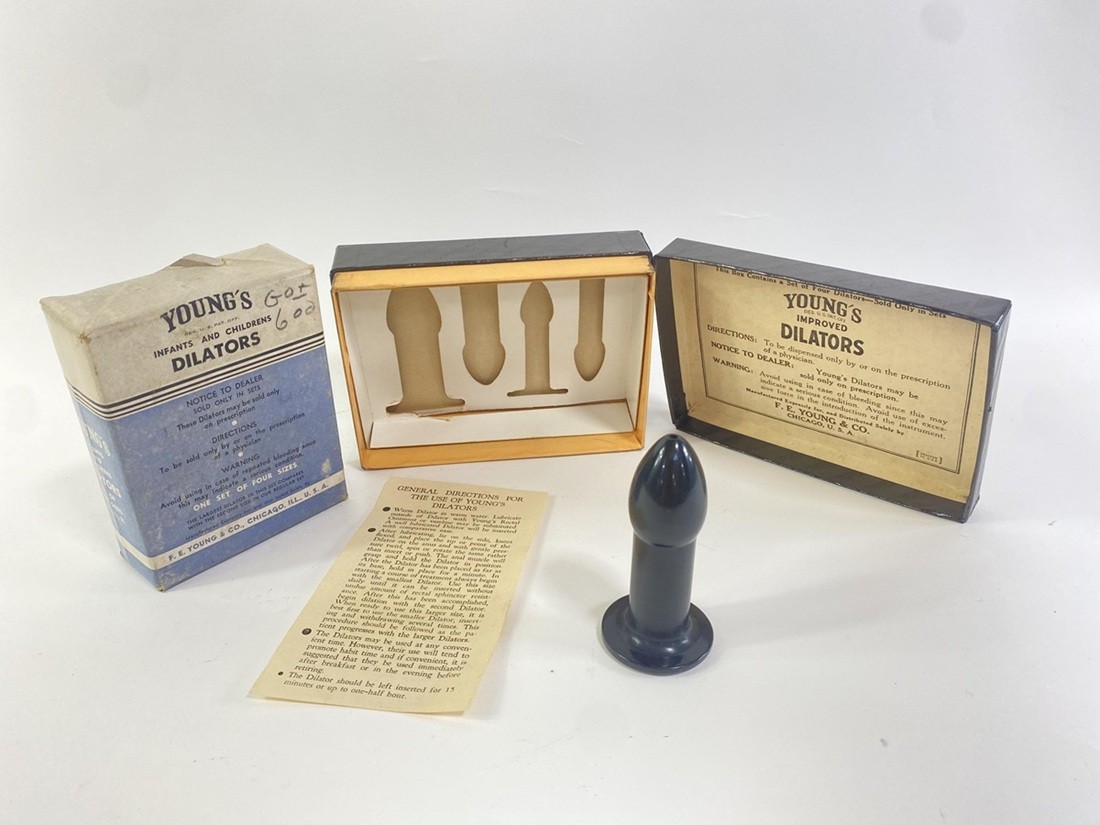
When most people hear the term “butt plug,” their minds jump straight to sexual toys. But what if I told you that these devices were originally designed for medical purposes? Far from their current association with pleasure, butt plugs began as tools intended to treat constipation, anal fissures, and even, surprisingly, mental health conditions.
Even today, doctors sometimes prescribe anal dilators to manage chronic constipation or to help with certain anorectal disorders. The first butt plugs, in fact, were developed for precisely these reasons. In 1892, an American doctor named F. E. Young patented a set of four differently sized anal dilators. According to Young, these devices were versatile remedies: they could address constipation, hemorrhoids, digestive issues, insomnia, headaches, eczema, and even nervous disorders. Men were advised to use them for prostate problems, and women could use them during pregnancy or menstruation. Remarkably, Young encouraged regular use even while sleeping claiming that it could only bring benefits.
Humanity’s interest in treating anal conditions goes back thousands of years. Ancient records, including a Babylonian stele containing Hammurabi’s laws (discovered in 1910), outline penalties and fees for medical treatment of bowel diseases, revealing how seriously society took these conditions. Egyptian papyri include remedies for hemorrhoids, while Hippocrates, in the 4th century BCE, developed early versions of instruments resembling modern speculums. Fast-forward to the 17th century, and French surgeons gained fame after successfully treating rectal fistulas in high-profile patients, such as King Louis XIV. Even in the 18th century, unconventional methods were used in resuscitation, with smoke blown into the rectum of those thought dead from drowning a practice applied in Hungary and elsewhere.
Returning to Dr. Young, he promoted his dilators not merely as medical devices but as almost miraculous tools. He introduced them through a journal he founded called New Way in March 1893, presenting the set as a revolutionary approach to health. However, the medical community was skeptical. A month later, Harvard Medical News responded with a sharp critique, questioning the validity of claims that these dilators could cure so-called “insane” patients or a wide array of other ailments. Young’s marketing promised cures for conditions ranging from constipation and hemorrhoids to nervous disorders, eczema, headaches, and digestive problems. It’s no surprise the professional response was cautious.
Despite this, Young’s devices remained on the market for decades, suggesting they were popular. Yet his claims eventually ran into legal trouble. In 1940, a shipment of his dilators was seized in New York and destroyed, as the courts determined the advertised health benefits were false and the recommended usage could be unsafe. This marked the end of the era of medical dilators being promoted as panaceas, but the product itself was far from forgotten.
So how did a medical instrument evolve into a sexual device? The answer seems simple: many of Young’s customers were likely more interested in pleasure than treatment. Over time, the medical association faded. In the 1960s, Germany saw the opening of its first sex shops, followed by the development of silicone-based toys. By the 1990s, butt plugs had firmly entered mainstream sexual culture. What began as a medical innovation gradually found a new life as an instrument of personal pleasure.
Today, butt plugs are primarily recognized as sexual toys, but their unusual history reminds us that many innovations have unexpected origins. What started as a medical solution for anal and digestive issues eventually became a widely used tool for sexual exploration. It’s a fascinating journey from medicine to modern sexuality, demonstrating that the path from health to pleasure is sometimes shorter than we think.